Call for Participation
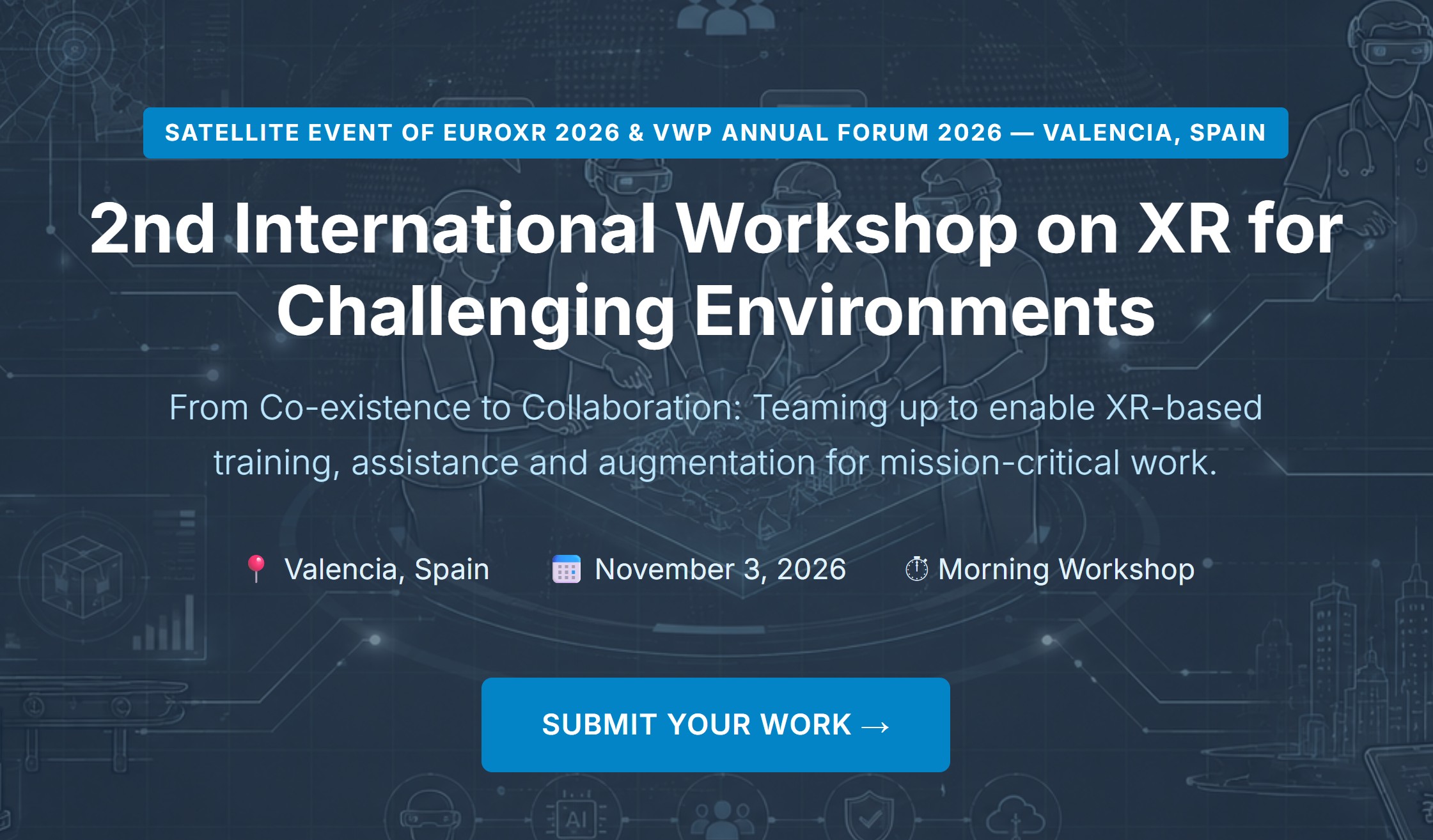
Challenging environments such as emergency response, public safety, advanced manufacturing, or space missions demand high levels of human performance under stress. This workshop investigates how XR-based training, assistance and augmentation can support people working in high-stakes, uncertain, and demanding contexts. To successfully address this challenge, enabling and nurturing active collaboration among actors (practitioners, researchers, technologies, systems) on different levels is essential.
Topics of Interest
We welcome 2–4 page position papers featuring novel concepts, empirical findings, provocative statements, or case studies addressing topics including:
- The Augmented Professional: Cognitive load, skill evolution, and human agency in mission-critical XR use.
- Human-AI Teaming: Moving beyond AI as a tool toward AI as a team member — shared situational awareness, role negotiation, and real-time coordination in high-stakes XR environments.
- Multi-Agent Coordination: Design challenges for environments where humans, robots, and AI agents share the same operational and information space without stepping on each other.
- Multi-Stakeholder Design: Co-designing XR for challenging environments with operators, managers, regulators, and end-users as active participants rather than informants.
- XR as a Collaboration Medium: Using XR to support shared awareness and communication among distributed or co-located teams in challenging environments.
- Cross-Domain Knowledge Transfer: What emergency medicine can learn from military XR, what industrial operations can borrow from healthcare — and how to make that transfer systematic.
- Design for Operational Deployment: Building XR systems that hold up under field realities: degraded communications, physical stress, time pressure, and environmental uncertainty.
- Transfer of Training: Which skills, habits, and mental models carry over from XR training to live deployment, and which break down under real operational conditions?
- Researcher-Practitioner Partnership: Structures and formats that enable genuine two-way learning between academic researchers and field experts, beyond one-off consultation.
- Cross-Disciplinary Research Integration: How HCI, AI, cognitive science, and domain practice can move from parallel work toward genuinely integrated XR4CE-related research agendas.
- Case Studies: XR-in-use experiences and lessons learned from emergency response, industrial operations, healthcare, and other challenging environments.